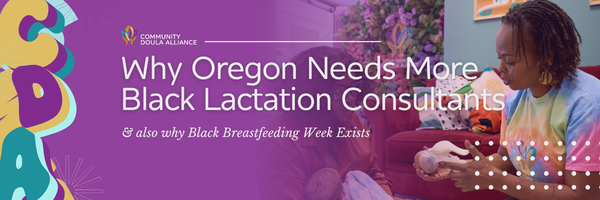
Why Oregon Needs More Black Lactation Consultants + Why Black Breastfeeding Week Exist
Every August, we celebrate National Breastfeeding Month. But from August 25–31, we acknowledge Black Breastfeeding and how deeply important it is not just for black families but for the reputation and advancement of maternal health care. Black Breastfeeding Week exists because Black mothers and babies have historically been disproportionately robbed of the joy of successful, meaningful chest/breastfeeding journeys and bonding experiences with our infants. We continue to experience inequities that require our undivided attention, advocacy, celebration, action and change from our community and health care professionals. Black women and children are dying at higher than acceptable rates and this keeps me awake at night. This week was created to center Black families, Black bodies and the love we have for our culture and wellbeing as black people. We deserve the right to celebrate Black breastfeeding, lactation traditions and address the barriers that can make breastfeeding more difficult for Black mothers and parents.
This year’s Black Breastfeeding Week theme is “We All We Got: 14 Years of Community, Care, and Collective Power.” (Source: Black Breastfeeding Week)
Why does Black Breastfeeding Week matter?
Statistics tell us that there is still work to be done and we will not stop until things improve.
According to the CDC, in 2024 the maternal mortality rate for Black women in the US was 44.8 deaths per 100,000 live births, compared to 14.2 deaths per 100,000 for White women. This means Black women experienced maternal mortality at more than three times the rate of White women. CDC: Maternal Mortality Rates in the United States, 2024
The disparities continue for our babies. In 2024, Black infants had the highest infant mortality rate amongst major racial and ethnic groups in the US, at 10.98 deaths per 1,000 live births, compared to 4.41 for White infants. CDC: Infant Mortality, 2024
Chest/Breastfeeding is not going to solve all the racial disparities in maternal and infant health, but it is an important step to getting access to lactation support that does not discriminate based on one’s race, language spoken, income, place of origin etc.
Health care providers, Doulas, Lactation Consultants, Allies and other Birth workers, here are some important questions to ask yourself when supporting Black families and their infants.
- What barriers do Black families face and what can I do to remove them?
- Why is representation in lactation care important?
- Who are the Black lactation consultants (IBCLC’s), Counselors and Educators in my area that I could refer black families to, that aid in culturally specific care?
An important part of the answer is increasing access to Black Lactation Consultants & Professionals.
Oregon needs more Black lactation consultants because Black families deserve more options, more representation and more culturally responsive care.
When Black mothers are accessing care from a lactation consultant, we deserve to feel heard, safe, respected and be approached with a trauma informed lens. It should be standard practice to provide culturally competent practices and training in health care. As people from diverse backgrounds are a part of the population of lactating individuals and maternal health, we should not be exempt. We deserve someone who understands that breastfeeding does not happen in exclusion and dismissal but in evidence-based support, cultural competency and access to care, equal opportunity to care and a compassionate approach .
Culture, family history, birth experiences, trauma, community support and previous experiences with racism can all influence a parent’s breastfeeding journey. Being supported by someone who lacks this understanding can ultimately result in families not seeking support from others as these experiences create trauma and unsafe environments to an already tired and fragile mother/parent during the postpartum period.
In Oregon, our state recognizes that more work is needed, and it is going to take all of us.
The Oregon Health Authority(OHA) has specifically identified increasing the availability of breastfeeding support from professionals as an area for action, including efforts to increase the number of racial and ethnic International Board Certified Lactation Consultants (IBCLC’s) and provide mentoring and preceptorship opportunities for people entering the field. Oregon Maternal and Child Health: Breastfeeding Recommendations
This matters because Oregon already has strength in the overall breastfeeding numbers. More than 90% of Oregon mothers begin breastfeeding. But statewide averages can hide disparities within communities. Oregon Health Authority (OHA) has acknowledged breastfeeding disparities and the need to understand the barriers that affect a family’s ability to meet their breastfeeding goals. Oregon Health Authority: Breastfeeding Rates and Data
We can’t celebrate high statewide breastfeeding rates and assume every family has equal access to support because we also have to acknowledge that Black voices go unheard and are not always represented. We need to invest in Black lactation consultants and professionals.
If we want better outcomes for Black mothers and our babies. We need to invest in the professionals who provide and serve Black families, who are already doing the work, who devote their time and energy in positively impacting their communities.
Representation alone will not eliminate health disparities, but culturally responsive care will create positive change.
To make that happen, this means creating more pathways for Black people to become lactation consultants.
It means mentorship, scholarships, clinical opportunities, education and community-based training.
That means hospitals, health systems, public health organizations, and policymakers intentionally recruiting and retaining Black lactation consultants and professionals. It also means recognizing the value in Doulas, Lactation Counselors/Educators and other trusted community birth workers who help families navigate pregnancy, birth, postpartum recovery, and lactation.
Beginning January 1, 2026, Oregon expanded coverage for culturally specific perinatal services, including lactation counselors and lactation educators, through commercial health plans and the Oregon Health Plan (OHP). Oregon Health Authority: Black Maternal Health Week 2026
This is an opportunity to build a better, more robust culturally responsive support network not just during Black Breastfeeding Week, but throughout each year. Black Breastfeeding Week is a celebration of our legacy, our babies, our bodies, our history and our communities. It is also a reminder that celebration and advocacy can co-exist.
Bottom Line –
During this Black Breastfeeding Week, let’s do more than acknowledge the disparities. Let’s invest in solutions for change, support Black lactation professionals and advocate for more training, listen to Black families and let’s create the kind of community where every Black mother and baby has the opportunity to thrive like our counterparts.
Lastly, we get to celebrate the Black mothers who breastfeed and honor the mothers who wanted to breastfeed but did not have the support they needed for success. We can celebrate every body feeding journey without judgment. We can work toward a better future where Black families have access to knowledgeable, culturally responsive lactation support from professionals who understand them and value their voices, like myself!
Many thanks to Aleecia Hodges for writing this guest blog post. She is the owner of Afroshelle Doula Services, which provides culturally responsive Full Spectrum Doula and Lactation support and care to Black families and their infants. You can learn more about her below:
- Check out her practice here – Afroshelle Doula Services
- Follow her on Instagram @afroshelledoula
- If you’re an OHP member, click here to hire her for birth and postpartum support
Ready to support the advancement of maternal care and train more birth workers like Aleecia?
Become a monthly donor and fund CDA’s innovative training programs!