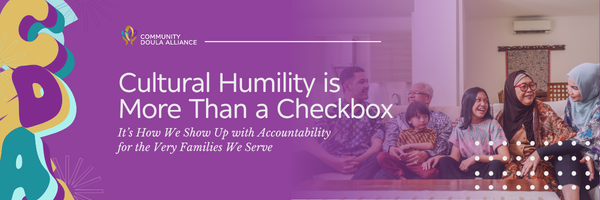
Cultural Humility Is More Than a Checkbox — It’s How We Show Up with Accountability for the Families We Serve
Families of color don’t need a doula who tolerates their culture. They need a doula who is part of it.
Let’s be honest: the birth work field has a problem. And it’s not just a pipeline problem, not just a diversity problem, it’s a power problem. Too many doulas enter the room with a folder full of certifications and a head full of assumptions, and call that readiness. It isn’t.
Black women in the United States die from pregnancy-related causes at two to three times the rate of white women. Indigenous women face similar disparities. These are not random statistics. They are the documented outcomes of systems that were never designed to protect these families and if we, as doulas, are not actively working against those systems, we are working within them.
Cultural humility is our entry point into doing better. Not cultural competence which implies there is a finish line but cultural humility, which demands continuous unlearning, accountability, and a willingness to be corrected by the very families we serve.
What Cultural Humility Actually Looks Like in the Birth Room
It looks like a doula who asks about traditions before assuming they know them. It looks like someone who understands that “informed consent” means nothing if a family doesn’t feel safe disagreeing. It looks like not translating a family’s cultural practices into palatable language for the medical team and instead advocating that the medical team adapt.
This work also means holding space for the weight that families carry into that birth room. Generational medical trauma. The specific exhaustion of having to advocate for themselves in spaces that dismiss them. The grief of families who lost someone before to the same system. A culturally humble doula doesn’t ask families to set that weight down. They help carry it.
“Anti-oppression work isn’t a specialty niche. It is the minimum ethical standard for anyone accompanying families through the most vulnerable moments of their lives”
Practical Tips for Anti-Oppressive Doula Care
- Do your own internal work first
Examine your racial identity, class background, and assumptions about “normal” birth. Bias you haven’t named is bias you’ll act on.
- Ask, don’t assume
Use intake conversations to ask about cultural traditions, language preferences, spiritual practices, and who the family defines as support people.
- Believe families when they name harm
If a client tells you a provider spoke to them disrespectfully or ignored them, do not seek to understand the provider’s side first. Advocate.
- Know your referral network
Have relationships with culturally specific therapists, lactation consultants, and community healers, especially those who share your clients’ backgrounds.
- Challenge your learning spaces
Who teaches your doula trainings? Whose voices are centered? Seek out people of the global majority-led birth work organizations and invest there with your dollars and attention.
- Receive feedback WITHOUT defensiveness
When a client or peer names something you did that caused harm, your job is to listen, repair, and change NOT to explain your intentions.
Anti-Oppression Is Ongoing — Not a One-Time Training
One workshop on implicit bias will not make you an anti-oppressive doula. Reading one book on the history of obstetric racism will not make you an anti-oppressive doula. These are starting points, not destinations. The work is a daily practice in how you market your services, how you price them, who you accept pro-bono, and how you show up in community spaces outside of births.
Ask yourself regularly: Are my services actually accessible to the families most at risk? If your sliding scale stops at a price most low-income families still can’t afford, that’s a gap. If your website is only in English in a bilingual community, that’s a gap. If every doula in your collective is white, that’s not neutrality, that’s a choice with consequences.
Community Doula Alliance exists because birth equity is a community project. No single doula can dismantle systemic racism, but together, practicing with intention, holding each other accountable, and centering the families most harmed by these systems, we become part of the change that birth workers were always called to make.
Resources & Further Reading
Nina Martin & Renee Montagne — foundational reporting on racial birth disparities
Jazmin Orozco Rodriguez — disparities faced for rural Indigenous populations
Research, training, and advocacy centered on Black maternal health
Policy change, research, and community organizing for Black maternal health
Work With Us
Community Doula Alliance offers sliding-scale support, community births, and culturally grounded doula care. We also publish monthly resources, training opportunities, and advocacy updates for birth workers committed to equity work.
To connect with a doula to get support, fill out this form
Curious about our next training, sign up for the waitlist here
Support families and doulas who want to be trained by becoming a monthly sponsor
- Got questions? Email [email protected]
- Join the conversation on Facebook Instagram: @communitydoulaalliance