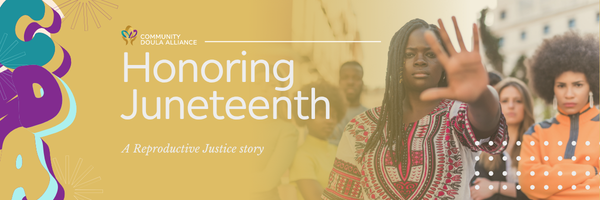
Juneteenth, a Reproductive Justice story.
When the last enslaved people in Galveston, Texas were given their freedom two years after the Emancipation Proclamation on June 19th, 1865, bodily autonomy and human rights proved to be an ongoing struggle for the newly freed Black population in the United States. While Black communities in Texas and beyond have celebrated Juneteenth for over a century and it is more recently a federally recognized holiday, the reality of agency, self-determination, and freedom for Black descendants of U.S. chattel slavery remains a paradox.
Black women, as mothers, parents, aunties, and caregivers, know all too well the complex nature of holding both joy and grief in the struggle for human rights, specifically reproductive rights. Since Emancipation and through the Civil Rights era, growing access to education, health care, and social mobility (though limited and not accessible to all) gave way to autonomous thought and decision-making around reproduction. Black midwives, activists, scholars, and storytellers have contributed their voices and actions to combatting medical apartheid, sexual violence, and birth injustice at the intersection of race, gender, and class oppression. They remind us that the oppression we experience is constructed and preventable, aka systemic. They also remind us that we, as a people, continue to perform fugitive acts and rebel against the ongoing discriminatory and prejudicial actions of this nation. Before freedom was granted, we seized and claimed it for ourselves in big and small ways, in private and public life. Juneteenth is a historical event and a cultural memory that carries a legacy of resilience and perseverance on the continuous journey of hard-won freedoms. As we are still seeing political agendas and legislation that targets and attempts to control Black bodies, invoking the power of our elders and ancestors, devising liberatory frameworks, and restoring ancestral practices remains vital to our livelihood.
This Juneteenth, I recall the memory of the granny midwives and medicine women of my lineage on my father’s mother’s side: Sophronia Mae, Repsie, Annie, and Alice. These women grew their families in the rural pastures of Sampson County, North Carolina in the late nineteenth and early twentieth centuries. All of them were born and gave birth at home at a time home births were the only option for Black communities. The home was, and continues to be, one of the main sites of justice and freedom-making, particularly around health and well-being, for us. My grandmother shared that when she was 6 or 7 years old, she came down with rheumatic fever, experiencing unceasing chills, sweats, and inflammation. She remembers her mother, Alice, and her grandmother, Sophronia Mae, foraging in the woods for herbs and flowers to nurse her back to health. They laid my grandmother on a cot propped up on two stools, wrapped her body in blankets, and placed steaming herbs and oils underneath the cot to support to move the fever out. Through late nights and early mornings, my great-grand mother and great great grandmother whispered scriptures and laid hands over my grandmother. Prayer, song, and plant medicine miraculously healed her body. When telling this story, Grandma is sure to give thanks. Without the knowledge and skill of her mother and grandmother, she would not be alive. My existence today is a product of the ingenuity of my ancestors. Of the ways they reclaimed their rights and practiced reproductive justice in their day to day lives. Of the ways they harnessed and shared wisdom from their elders to maintain family survival and prosperity. When I think of freedom, this ancestral memory invigorates my spirit.
Stories of granny midwives and traditional healers illustrate the practices of freedom that Black people have always lived. This is the inheritance of Black birthworkers and community workers like myself, those who work at CDA, and across the nation. Our ancestors carried deep wisdom and knowledge that worked to heal, conjure, birth, death, feed, create, perform, and nourish themselves and their loved ones in spite of under-resourced and unpredictable living and working conditions. This is what we carry into the work of caring for families and living as advocates for reproductive justice. As we commemorate this Juneteenth, I hold space for both the reality of (un)freedom for Black folks in this country and the ways we continue to liberate ourselves again and again.
The Path Forward: Liberation through Care & Reproductive Justice
-
Fund community-based doula programs at the local, state, and national level
-
Ensure Medicaid reimbursement includes doulas and respects their expertise
-
Support nonprofits and training orgs that are creating accessible pathways for doulas of color
-
Elevate community voices in maternal health policy conversations